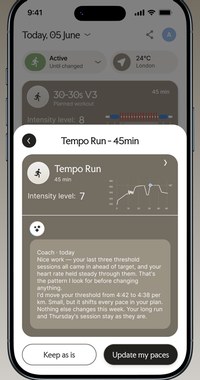
"Is a tempo run the same as a threshold run?" I get asked this a lot at this time of year, when spring marathon and half marathon plans start landing and suddenly every Tuesday says "tempo" or "threshold" on it. Different plans, watches and coaches use the two words in slightly different ways, so it's no wonder people get confused.
The short answer is that they overlap a lot, and for most runners the difference matters less than getting the effort right. But there is a difference, and once you understand it you'll get a lot more out of these sessions. I'm a UK Athletics and UESCA qualified coach, and these are some of the sessions I set most often for marathon and half marathon runners, so this is how I think about them.
What is a threshold run?
A threshold run is a session run at, or just under, the hardest effort you can hold where your body is still more or less in balance. Lactate is being produced and cleared at roughly the same rate, your breathing is hard but rhythmic and you feel like you're working, but you're not hanging on.
Scientists have argued about how to define that point for decades. A review by Faude and colleagues found 25 different lactate threshold concepts in the research (Faude et al., 2009). Most of them fit into a model with two breakpoints: the first point where blood lactate starts to rise above resting levels, and a second, higher point that is the highest intensity where lactate production and clearance are in balance, the maximal lactate steady state.
When coaches say "threshold" they usually mean that second, higher point. Research from the University of Exeter suggests the true boundary sits a little above the maximal lactate steady state as it's normally measured, and that effort right at that boundary (critical power or critical speed) can only be held for something like 20 to 30 minutes (Jones et al., 2019).
So in practice I treat threshold as a narrow band rather than an exact number. And that's why I'd always rather you run it a touch too easy than a touch too hard.
What is a tempo run?
"Tempo" is a looser word. Some coaches use it to mean exactly the same thing as threshold. Others use it for a steady, comfortably hard run that sits somewhere between marathon pace and threshold. And plenty of runners use it for "a run where I go fairly quick", which is where things tend to go wrong.
When I write "tempo" in a plan, I mean a continuous run at a comfortably hard effort, usually a little slower than threshold, held for longer. When I write "threshold", I mean a slightly harder effort, often broken into blocks with short recoveries so you can do more total time at that intensity without it turning into a race.
Tempo run vs threshold run: the practical difference
Here's how I'd separate them for most club runners. These are my rules of thumb from coaching, not lab numbers, and your own will depend on your fitness and how long you've been running.
- Threshold. Roughly the pace you could race for about an hour. For a lot of runners that sits somewhere between 10K and half marathon race pace. Effort around 7 to 8 out of 10. You can say a few words, not a sentence.
- Tempo. A little easier than threshold, roughly between half marathon and marathon pace for most people. Effort around 6 to 7 out of 10. You could just about speak in short sentences, but you wouldn't want to.
- Too hard. If you're at 10K race effort or quicker, you're no longer doing a threshold or tempo session. You're doing a race. It might feel good on the day, but it costs you far more recovery and usually wrecks the next few sessions.
The talk test is a really useful check here, especially if your watch pace is all over the place on hills or in the wind. If you can't get a few words out, ease off.
How fast should a tempo run be?
This is the question behind most of the searches, so let's be specific. For most runners I'd aim for a tempo pace somewhere between your current half marathon pace and your marathon pace, and I'd base it on what you can run now, not on your goal time.
That last bit is the one people get wrong. If you're hoping to run 3:30 at a spring marathon but your current fitness says 3:45, training at 3:30 effort for your tempo runs in December means you're running too hard, every week, for months. I say this all the time... train for the fitness you've got, and the fitness you want tends to follow.
If you've had a lactate test or a recent race, use those numbers. I've written more on that in how to use lactate profiling to set your training zones, and if you train by heart rate, heart rate zones for running explains how the zones fit together.
Why bother with either?
Because they work, as long as they sit inside a week that's mostly easy. A systematic review of highly trained and elite distance runners found they mostly follow a pyramidal pattern: lots of easy running, a smaller amount in the zone between the two thresholds, and the least time above threshold. Continuous tempo runs and longer intervals at threshold were used at least once a week, and marathon runners leaned more on that middle zone than 1500m runners did (Casado et al., 2022).
That fits with Stephen Seiler's work on how endurance athletes distribute their training, where the large majority of sessions are done at low intensity (Seiler, 2010). The threshold work matters, but it only works because the easy running underneath it is genuinely easy. If your easy days are creeping up, have a read of why easy running matters.
The way I explain it to athletes is that we push our thresholds up from underneath, not pull them up from above. Lots of easy aerobic running, then a controlled dose of threshold work, done consistently for weeks. Smashing yourself at 10K pace every Tuesday doesn't do the same job.
Threshold and tempo sessions I use
These are typical sessions I'd put in a marathon or half marathon build. Always warm up with 10 to 15 minutes easy, and cool down with 10 minutes easy.
Threshold sessions
- 5 x 5 minutes at threshold with 1 minute easy jog between. A great first threshold session.
- 4 x 8 minutes at threshold with 90 seconds jog. A step up once the first one feels controlled.
- 3 x 10 to 12 minutes at threshold with 2 minutes jog. A pretty tasty session for experienced runners.
Tempo sessions
- 20 minutes continuous at tempo effort. Simple and effective.
- 30 to 40 minutes continuous at tempo effort, building over a few weeks for marathon runners.
- 2 x 20 minutes at tempo with 3 minutes easy between, a nice bridge into marathon-specific work later in the block.
A good rule of thumb is that you should finish a threshold or tempo session feeling like you could have done one more rep. If you're knackered and walking home, it was too hard.
How often should you do them?
For most amateur marathon and half marathon runners, one threshold or tempo session a week is plenty, alongside a long run and plenty of easy miles. More experienced runners might do two quality sessions a week, but I'd only add the second once the first is consistently controlled and recovery is good.
In a spring marathon build I usually lean on threshold work in the earlier weeks, then gradually bring in more marathon pace running as race day gets closer. If you're targeting London in the spring, the London Marathon race guide covers when your block should start and how it fits together.
Common mistakes
- Running them too fast. By far the most common one. If the session feels like a parkrun, slow down.
- Chasing pace on hills or in wind. Run by effort on hilly routes and windy days, and let the pace be whatever it is.
- Doing them on tired legs. Threshold work the day after a hard long run rarely goes well. Give it at least one easy day either side.
- Ignoring the easy running. If every run is a bit hard, the threshold sessions lose their punch.
Want your sessions set for you?
Getting the effort right is half the battle with this stuff, and it changes as you get fitter. If you'd like your threshold and tempo paces worked out for you, your week built around them and everything adjusted as your training goes, have a look at 1:1 coaching with Maximum Mileage. And if not, go a little bit easier next Tuesday. You'll probably be surprised how much better the session feels.
FAQs
Is a tempo run the same as a threshold run?
They overlap, and some coaches use the words interchangeably. I use threshold for a slightly harder effort, roughly what you could race for about an hour, often done in blocks. Tempo is a little easier and usually continuous.
How fast should a tempo run be?
For most runners, somewhere between current half marathon pace and marathon pace, at an effort of around 6 to 7 out of 10. Base it on your current fitness, not your goal time.
How long should a tempo run be?
Start with around 20 minutes at tempo effort, not counting the warm up and cool down. Marathon runners can build towards 30 to 40 minutes continuous over a few weeks.
What heart rate is a threshold run?
It varies a lot between people, so I wouldn't use a generic number. A lactate test, a recent race or a well set up zone system will give you a far better guide than a formula.
Can beginners do tempo runs?
Yes, once you've got a few months of consistent easy running behind you. Start with short blocks, such as 3 x 5 minutes at a comfortably hard effort, and build from there.
Sources
- Faude O, Kindermann W, Meyer T. Lactate threshold concepts: how valid are they? Sports Medicine, 2009.
- Jones AM et al. The maximal metabolic steady state: redefining the 'gold standard'. Physiological Reports, 2019.
- Casado A et al. Training periodization, methods, intensity distribution, and volume in highly trained and elite distance runners: a systematic review. International Journal of Sports Physiology and Performance, 2022.
- Seiler S. What is best practice for training intensity and duration distribution in endurance athletes? International Journal of Sports Physiology and Performance, 2010.
Header photo: Jogging along the old railway path by Des Blenkinsopp, CC BY-SA 2.0, via Wikimedia Commons.