Why Your Legs Fall Apart at Mile 20, and Why More Running Isn’t the Answer
You’re putting the miles in.
You’re doing the long runs.
You’re hitting the intervals.
You’re ticking off the sessions.
And then somewhere around mile 18, 19, 20…
Everything starts falling apart.
The hamstrings start threatening mutiny.
The glutes feel like concrete blocks.
Your stride loses all rhythm.
Your pace drifts further and further away.
And suddenly the final 10k becomes less of a race and more of a survival exercise.
Sound familiar?
Most runners assume this happens because they didn’t fuel properly, didn’t do enough mileage, or simply need to “toughen up mentally”.
Now look, all of those things matter. Fueling matters massively. Long runs matter. Mental resilience absolutely matters.
But there’s another reason this happens that hardly anybody talks about:
Your body loses the ability to produce force efficiently late in the race.
That’s the real issue.
And it’s exactly why strength training matters so much for marathon runners.
At Maximum Mileage, this is one of the biggest things we help runners understand. Most runners don’t actually need more training. They need training that supports durability properly.
The Real Reason the Marathon Gets Ugly
Every single time your foot hits the ground while running, your muscles and tendons absorb and return force.
Over and over again.
Somewhere between 30,000 and 50,000 times during a marathon.
Early in the race, your body handles this efficiently. Your running economy is good. Your stride feels smooth. Holding pace feels manageable.
But as fatigue builds, your muscles gradually lose the ability to produce force properly.
Your running economy starts to deteriorate.
The same pace suddenly costs more energy.
Your form starts compensating.
Your cadence changes.
Your hips begin dropping.
Your stride shortens.
Eventually, your body simply can’t hold the pace anymore.
That’s the wall.
Not just glycogen depletion.
Not just mindset.
Neuromuscular fatigue.
This is exactly why we programme strength work into our runners’ plans at Maximum Mileage. The goal isn’t just fitness. It’s durability when the race starts asking difficult questions.
Strength Training Is About Durability, Not Vanity
A lot of runners still think strength training is something bodybuilders do.
It isn’t.
You are not trying to become enormous.
You are not trying to look like you work nightclub security on weekends.
You are trying to become more durable.
You are trying to build a body that can continue producing force efficiently when the race gets hard.
And the research on this is incredibly strong now.
One recent study looked at runners doing just 10 weeks of heavy strength training alongside normal marathon training. The runners who lifted properly maintained better running economy after prolonged marathon-intensity running and significantly improved performance in fatigue conditions.
Another study on masters runners found maximal strength training improved running economy at marathon pace by over 6%.
Six percent.
People will happily spend £250 on carbon-plated shoes chasing marginal gains while ignoring one of the biggest performance improvements available to them.
Strength training is essentially free speed.
The Biggest Mistakes Runners Make With Strength Training
Here’s the problem though.
Most runners who do strength train are doing it badly enough that they get almost no benefit from it.
1. The Circuit Trap
You’ve seen these workouts before.
Thirty seconds on.
Fifteen seconds off.
Mountain climbers.
Burpees.
Bodyweight squats.
Press-ups until you collapse into a sweaty puddle on the gym floor.
It feels hard, so it must be productive, right?
Not really.
That’s mostly just cardio with extra admin attached to it.
And you already do cardio. You’re a runner.
The purpose of strength training is not to leave you gasping for air.
The purpose is to improve force production.
That requires actual load.
This is something we coach heavily at Maximum Mileage. Runner-specific strength work should complement your running, not just leave you exhausted for the sake of it.
2. The Tiny Dumbbell Problem
This one is unbelievably common with marathon runners.
Three sets of 25 lunges holding weights lighter than your weekly food shop.
Romanian deadlifts that barely challenge anything.
Goblet squats that never get remotely difficult.
If you can comfortably do endless reps, the weight is probably too light to create meaningful adaptation.
The improvements seen in research didn’t come from lightweight circuits and high reps.
They came from heavier lifting with lower repetitions.
That’s what teaches your body to produce force more efficiently under fatigue.
And no, you are not going to get bulky from lifting twice a week while simultaneously running 40 miles a week.
You’re fine.
3. Skipping Strength Entirely
This is classic runner logic:
“I’d rather just run more.”
But once you’re already running four or five times a week, adding another easy 5k often contributes very little additional fitness.
Meanwhile, strength training might be the exact thing stopping your body from collapsing at mile 20.
More mileage is not always the answer.
Better-supported mileage usually is.
Honestly, this is one of the biggest mindset shifts we try to help runners make at Maximum Mileage. The “unsexy” work is often the thing that unlocks the biggest improvements.
What Strength Training for Marathon Runners Should Actually Look Like
Good marathon strength training is honestly quite boring.
That’s a good thing.
You do not need circus exercises balancing on one leg while waving resistance bands around like inflatable tube men outside a car dealership.
You need consistency, progressive overload, and solid compound movements.
That’s it.
The principles are simple:
- Heavy-ish weights
- Low reps
- Compound exercises
- Repeatable sessions
The Most Important Exercises
Squats
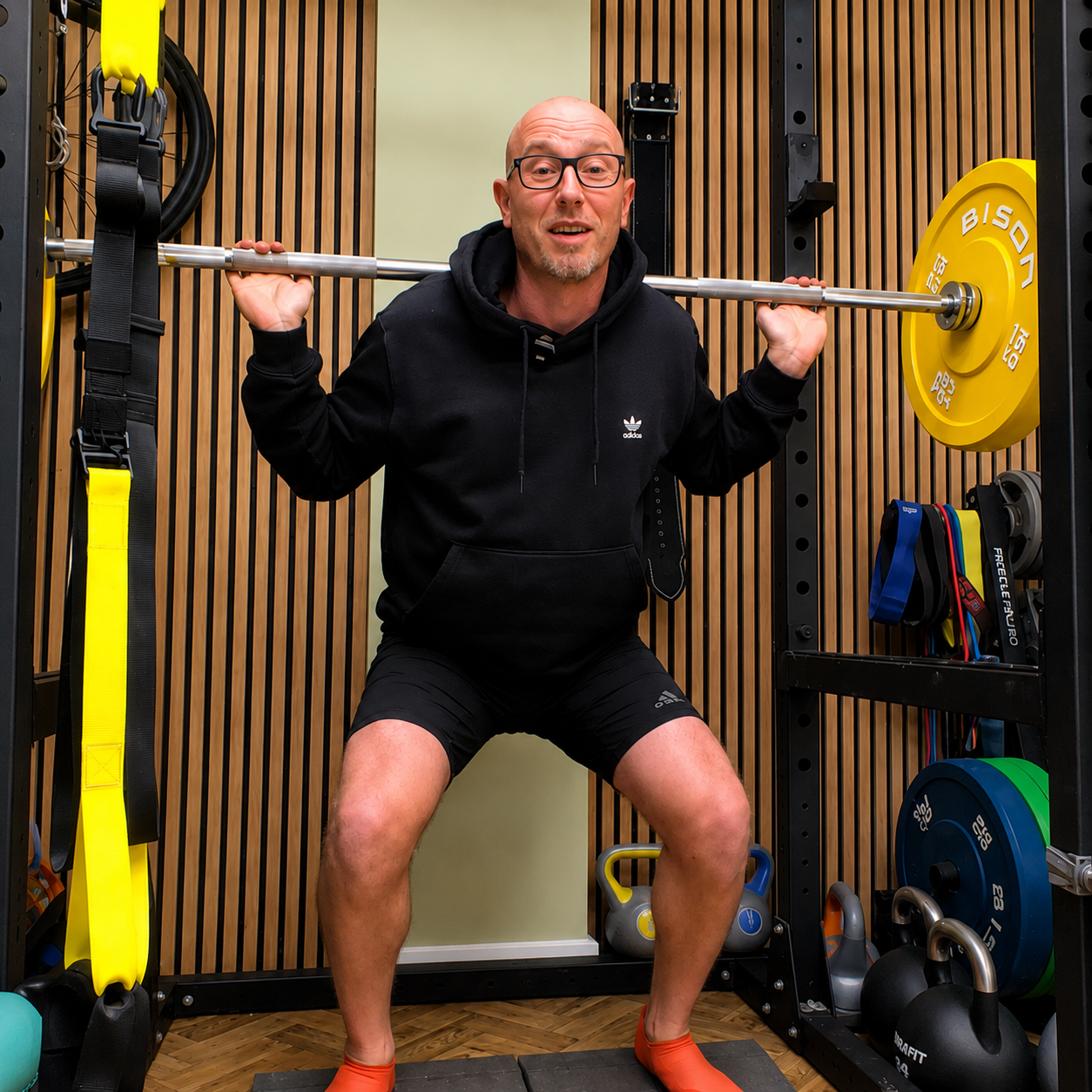
Back squats or heavy goblet squats.
Two to three sets.
Four to six reps.
Maybe up to eight.
If you could easily keep going afterwards, the weight is probably too light.
Romanian Deadlifts
Absolutely brilliant for runners.
They target the posterior chain, especially the glutes and hamstrings, which is where many runners are desperately weak after years of sitting at desks and staring into Zoom calls.
Again:
- 2–3 sets
- 5–8 reps
- Controlled and properly loaded
Single-Leg Work
Running is fundamentally a single-leg sport.
Split squats.
Lunges.
Bulgarian split squats, which are horrific but incredibly effective.
This is where you uncover left-right imbalances that often contribute to injury and poor running mechanics.
Calf Raises
Massively underrated.
Your calves and Achilles take an absolute battering during marathon training.
Heavy, slow calf raises through a full range of motion are gold for building durability.
Core and Upper Body
Not the priority, but still important.
Rows.
Pull-ups.
Presses.
Planks.
Pallof presses.
Your core’s job late in a marathon is to keep you stable when everything else is trying to fall apart.
How Heavy Should You Lift?
Here’s the easiest rule to follow:
You should finish most sets feeling like you had one to three reps left in the tank.
Not easy.
Not complete failure.
Just heavy enough that the final reps require proper effort.
And form always comes first.
A technically sound squat with moderate weight is infinitely better than some ego-driven monstrosity that folds you in half.
Where Strength Fits Into Marathon Training
This is where runners often panic.
“Won’t lifting ruin my running?”
Not if you programme it properly.
The biggest rule?
Never do strength training on the same day as your long run.
That’s a very quick route to feeling like you’ve been hit by a bus.
You also ideally don’t want heavy lifting immediately before key sessions like intervals or tempo runs.
For most busy runners, two strength sessions a week works brilliantly.
Something like:
- Tuesday: Quality run
- Thursday: Strength plus optional easy run
- Saturday: Long run
- Sunday or Monday: Second strength session
The exact layout matters less than consistency and recovery.
This is what I call diary Tetris.
You’re fitting training around work, stress, children, meetings, emails, and whatever other chaos adult life decides to launch at you that week.
At Maximum Mileage, this is a massive part of how we coach. The best training plan in the world is useless if it doesn’t actually fit into your real life.
What About During Taper?
Do not stop lifting completely before your race.
That’s a mistake.
Instead, reduce the volume while maintaining the intensity.
Keep the weights similar.
Do fewer sets.
Exactly the same principle we apply to marathon tapering itself.
You keep the neuromuscular system switched on without creating unnecessary fatigue.
Final Thoughts
The runners who hold themselves together late in races are rarely just the runners doing the most mileage.
They are usually the runners whose bodies are durable enough to keep producing force when fatigue arrives.
That’s what strength training gives you.
Not vanity.
Not bodybuilding.
Not punishment.
Durability.
The ability to still run properly when the marathon finally asks the real question at mile 20.
So yes, keep doing the long runs.
Keep doing the sessions.
Keep fueling properly.
But if your legs always fall apart late in races, the answer probably isn’t more running.
It might simply be time to go and lift something heavy.
And if you want help building marathon training around your actual life, schedule, recovery, and long-term progression, this is exactly how we coach at Maximum Mileage.
👉 Click Enquire Now to find out more about coaching.