A Conversation with Sarah Crouch on Pain, Fear, Longevity, and Letting Go
There’s a quiet fear I see in so many women runners.
After 35.
After kids.
After injury.
After time off.
It sounds like this:
“Did I miss my peak?”
On the Maximum Mileage Running Podcast, I sat down with professional marathoner, doula, and bestselling novelist Sarah Crouch. What she shared completely reframed that question.
Because according to Sarah?
Many women run their best marathons in their late 30s, 40s… even 50s.
Let’s unpack why.
The Myth of the Expiring Window
In Western culture, we’re conditioned to believe athletic performance has an expiration date. That after a certain birthday, it’s all downhill.
But Sarah has seen, both as an elite athlete and as a coach, that women often experience a resurgence in their late 30s and beyond.
Hormonal shifts can support strength and endurance.
Emotional maturity changes how we approach training.
Mental resilience deepens.
You’re not just training with legs. You’re training with life experience.
And that matters.
Especially if you’re coming back from a setback.
Pain Isn’t the Enemy. Fear Is.
One of the most powerful moments in our conversation was when Sarah said:
“Pain isn’t the enemy. Fear is.”
That hits differently when you’ve been injured.
Because for comeback runners, pain isn’t just discomfort. It’s a threat. It’s a warning siren. It’s memory.
But Sarah made a critical distinction between pain and fear.
Pain is part of racing. It’s information. It’s effort.
Fear is what tightens your body.
Fear is what makes you back off too early.
Fear is what keeps you from trusting your fitness.
She described two types of athletes:
- Acceptance athletes — “Okay. Bring it.”
- Avoidance athletes — distracting themselves, pretending they feel amazing.
Neither is inherently wrong. But you need to know which one you are and lean into it intentionally.
Winning races isn’t about aggression.
It’s about staying calm in chaos.
And that calmness? It can be trained.
The Chicago Marathon — 10 Days Post-Surgery
In 2018, Sarah discovered a tumor in her quad just weeks before the Chicago Marathon.
It was non-cancerous, but it needed to be removed. Immediately.
She had surgery 10 days before the race.
Cold rain. 12 mph winds.
She lined up anyway, not because she felt fearless, but because she felt grateful. The tumor pain was gone. She could run.
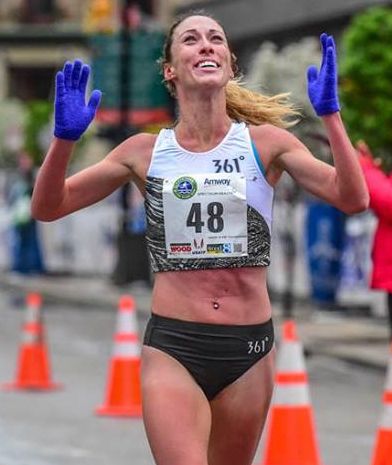
She finished as the Top American woman. With a PR.
Not because she overpowered the pain.
But because she didn’t let fear dictate the race.
Gratitude steadied her. Acceptance carried her.
That perspective shift alone is worth sitting with.
The Trap of the Data Watch
Another theme we discussed, and one I know many of you wrestle with, is watch attachment.
Sarah believes constant internal competition, even on easy days, ends careers.
Easy running has one job:
Repair muscle damage.
Move oxygen-rich blood.
Flush out fatigue.
If you can’t hold a conversation, it’s not easy.
It doesn’t matter what your watch says.
Letting go of pace pressure is especially important if you’re rebuilding. Your nervous system needs safety. Your body needs space to adapt.
Fitness grows in recovery.
Hills > Gym (Sometimes)
Sarah isn’t anti-strength training. She believes it should be individualized and purposeful, often as a way to stay healthy or address specific weaknesses.
But if you want a simple, high-impact addition?
Hill strides.
Four to six 20–30 second all-out hill sprints. Twice a week.
Hills force you to:
- Land under your center of gravity
- Lift your knees
- Engage power without overstriding
They build strength and speed with surprisingly little wear and tear.
For runners who feel stuck or plateaued, this is often the missing link.
Longevity Requires Play
When Sarah trained at ZAP Fitness in North Carolina, her coach incorporated fartlek runs, unstructured speed play, that kept training joyful.
Later in her career, hyper-quantified training and constant GPS metrics started to strip that playfulness away.
This is something I think about often.
If every run is measured, analyzed, compared, we slowly lose the magic.
Longevity in running isn’t just about durable tendons.
It’s about protecting your love for it.
Especially if you’re hoping to run into your 60s and 70s.
Rebuilding After Injury Requires Belief
If you are currently in a rebuild season, here’s what I want you to hear:
Your setback did not close your window.
It may have deepened your wisdom.
You may train smarter now.
Recover better.
Respect easy days.
Embrace strength.
Approach races with calm instead of panic.
That is not decline.
That is evolution.
Write What You’re Passionate About (In Running, Too)
Sarah now writes literary mystery novels set in the Pacific Northwest. Her latest book has landed on bestseller lists and even drawn film interest.
She said something that applies just as much to running:
“You can’t write a book that’s for everyone. Write what you’re passionate about.”
The same goes for your running.
You don’t need to chase someone else’s mileage.
Someone else’s pace.
Someone else’s timeline.
Build the season that excites you.
So… Is Your Best Running Ahead of You?
If you’re in your mid-30s or beyond and quietly wondering whether you’ve missed your moment, I hope this conversation challenges that narrative.
Your peak may not have passed.
It may simply require:
- Letting go of fear
- Trusting easy days
- Adding strength with intention
- Staying calm when racing
- And believing the window is still open
Because sometimes the strongest version of you isn’t the youngest.
It’s the wisest.
And that version?
She’s just getting started.
If you want help discovering the strongest, quickest version of yourself, click "Enquire Now".