When you have stood at the finish line for more than 500,000 athletes, you start to understand something about human potential.
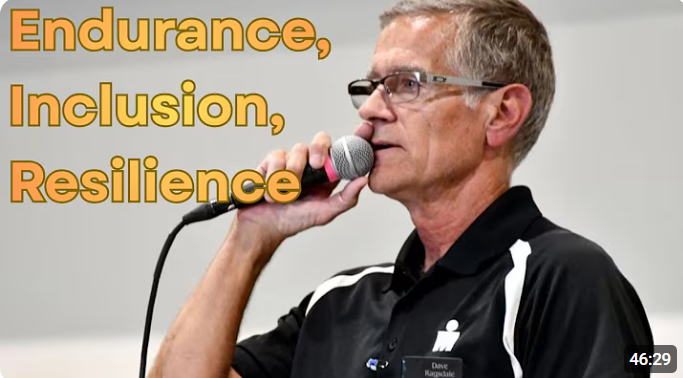
On a recent episode of the Maximum Mileage Podcast, I sat down with longtime Ironman announcer Dave Ragsdale, someone who has spent more than two decades inside the world of endurance sports. What unfolded was not just a conversation about triathlon history. It was a reflection on risk, resilience, community, and what really happens when a race or life does not go according to plan.
Here are a few takeaways that I think every endurance athlete, especially those building their comeback, needs to hear.
The Risk of Choosing the Hard Thing
Before the microphone, before Ironman, before announcing hundreds of thousands of finishers, Dave was a college runner working in container shipping sales.
Triathlon was not mainstream. There was no blueprint for turning it into a career. Walking away from a stable path to chase endurance sport was not the obvious move.
But he did it anyway.
In the 1980s, South Florida became a kind of grassroots triathlon hub. A traveling series of events that included a run, skate, kids triathlon, sprint triathlon, and expo moved across the state like a family fitness circus. Athletes showed up weekend after weekend. It was scrappy. It was new. It was community driven.
Most participants were runners learning to swim because they had to. There was no polished pipeline and no Olympic scouting system. Just curious, competitive people willing to try something uncomfortable.
That willingness to step into the unknown is still the heart of endurance sport.
The First Job of an Announcer: Calm the Storm
At major Ironman events, Dave’s job starts days before the race. He hosts athlete briefings, thirty minute sessions covering logistics, transitions, course details, and expectations.
But what he is really doing is managing anxiety.
Athletes often preface a question with, "This might be stupid..."
His response is always the same: "The only stupid question is the one you do not ask."
It is simple. But it matters.
Because nerves make people second guess everything. They forget the order of events. They wonder if they should change outfits between disciplines. They consider wearing brand new socks on race day.
Anxiety shrinks when information grows.
There is a coaching parallel here. When athletes set clear A, B, and C goals before race day, something powerful happens. If the A goal slips away, the race does not unravel. There is structure. There is perspective. There is something to keep moving toward.
Goal setting is not about rigid outcomes. It is about emotional durability.
What Unraveling Really Means
At some point in longer races, especially those lasting more than three hours, the plan almost always cracks.
Nutrition goes sideways. Pace drifts. The weather shifts. The legs stop cooperating.
Dave calls this the moment when the train goes off the tracks.
The athletes who finish strong are not the ones whose race goes perfectly. They are the ones who regroup.
That skill, adjusting instead of quitting, is not just athletic. It is life.
Sometimes the bravest decision is to keep going with a new plan.
Sometimes the bravest decision is to step off the course and live to fight another day.
Both require self awareness.
The Finish Line Is a Mirror
For Dave, the emotional payoff comes after the work is done.
He steps behind the finish line during breaks and just watches.
The moment someone crosses an Ironman finish line is rarely subtle. There are tears. There is disbelief. There is laughter. There is collapse. There is a split second where triumph turns into realization.
"I actually did that."
In recent years, those moments have grown even more powerful as the sport has become more inclusive. Paratriathletes. Athletes with prosthetics. Athletes with intellectual disabilities like Chris Nikic, the first athlete with Down Syndrome to complete an Ironman.
To an outsider, it might look like just swimming, biking, and running.
But to anyone standing at that finish line, it is visible proof of the depths people can dig into when they decide not to quit.
The Ironman mantra, "Anything Is Possible", can sound cliché.
Until you see it.
Endurance Sport as an Unknown Frontier
One idea that stayed with me from our conversation was this. Endurance sport is a journey into unknown unknowns.
You discover things you did not even know you did not know about yourself.
In a world obsessed with certainty and control, endurance sports remain one of the last frontiers where you cannot fully predict what will happen. You prepare. You train. You plan.
And then you step into uncertainty anyway.
For many athletes, especially those returning from injury or rebuilding after a setback, that is the real work. Not just regaining fitness. Regaining trust.
Why This Matters for Comeback Athletes
If you are rebuilding, here is what I hope you take from Dave’s decades at the microphone.
Ask the question. There are no stupid ones.
Set layered goals. A, B, and C keeps the day from becoming a failure.
Expect the unraveling. It is part of the process.
Understand that the finish line is emotional because growth always is.
Remember that what feels unknown now will someday become your proof.
You do not need a microphone to validate your effort.
You do not need a crowd to make it meaningful.
But you do need the willingness to step into something uncertain.
And that is where endurance sport becomes more than training miles. It becomes expression. A way of saying, without words,
"I am still here. I am still trying. Let’s see what is possible."
If there is one nugget from this conversation that I hope sticks, it is this.
Anything is possible.
Not because it is easy.
Not because it is guaranteed.
But because you are capable of more than you currently understand.
And sometimes, you only discover that by crossing a line you were not sure you could reach.